Thomas Jefferson wrote about his experience in Virginia during this time and noted its effect on crops:
May 17, 1816
"[T]he spring has been unusually dry and cold. our average morning cold for the month of May in other years has been 63° of Farenheit. in the present month it has been to this day an average of 53° and one morning as low as 43°. repeated frosts have killed the early fruits and the crops of tobacco and wheat will be poor."
September 1816
"We have had the most extraordinary year of drought & cold ever known in the history of America. in June, instead of 3 3/4 I. our average of rain for that month, we had only 1/3 of an inch, in Aug. instead of 9 1/6 I. our average, we had only 8/10 of an inch. and it still continues. the summer too has been as cold as a moderate winter. in every state North of this there has been frost in every month of the year; in this state we had none in June & July. but those of Aug. killed much corn over the mountains. the crop of corn thro’ the Atlantic states will probably be less than 1/3 of an ordinary one, that of tob[acc]o still less, and of mean quality."
Many of us could not be brilliant polymaths. Also, they did have wealth via slavery plantations that allowed them fancy tutors, expensive libraries, and top class educations.
I think many of us could. I imagine as long as you have some minimal level of intelligence and some high degree of motivation. Incidentally, Benjamin Franklin, who did not own a plantation, founded one of the first book lending clubs which would later evolve into public libraries.
Many of us could, but would not be. After all, there was a lot of time without any digital distractions. I don't think digital distractions is what keeps us from educating ourselves.
You may know more than them, yet you merely stand on the shoulders of ever taller giants. Discounting the expense and difficulty of knowledge at the time isn't very illuminating.
I'm not disputing that. I'm responsible for zero new discoveries and if some of these polymaths were alive today, they would be far smarter than I am. However the "a lot" they knew about dozens of subjects combined is less than what somebody who is learned in one of those subjects would have to know today. It's impossible for somebody to be working on, say, string theory and also be an expert in two other subjects. There's simply too much to know.
I mean, look at Elon Musk and John Carmack. Pretty good counter examples to the narrative that you can't be good at more than one domain. Yes, they're very smart, but they're also very focused and driven individuals.
There may be more that is knowable now than back then, but I doubt you or I actually know more than an educated person back then. We just know different stuff.
> There may be more that is knowable now than back then
That is not true. I guess you mean in the sense that our horizons have broadened because we have access to so much more information than people used to have, but in terms of things that can be known, nothing has changed. The facts of the universe are the same as they ever were.
This bit is about weather and crops more than it is about science. It is not a surprising knowledge, given that the US were essentially an agrarian society back then.
> The lack of oats to feed horses may have inspired the German inventor Karl Drais to research new ways of horseless transportation, which led to the invention of the draisine or velocipede. This was the ancestor of the modern bicycle and a step toward mechanized personal transport.
This truly captures the "butterfly effect" which I continually marvel at. How much of what has happened in human history has been because of a seemingly entirely unrelated series of events? Probably quite a lot.
I'd highly recommend the TV series Connections[0], which explores the history of science and technology through the lens of this sort of butterfly effect. There were a couple later reboots of the series that are not as good IMO, but still worth a watch.
Connections is a fantastic series, it's a lot of fun and I loved it as a child.
My concerns about it is that too many people seem to imagine that because historically an outcome had a cause, that therefore that cause must have been necessary, and that therefore the outcome could never have happened without that specific cause. If they Fluyt, a type of Dutch cargo ship had not been invented, would we really have never developed plastics? So the series provides a very valuable insight into historical processes, but some people seem to take that to implausible extremes. A case in point is the many examples of technologies being independently developed by different people under very different circumstances.
Not so much necessary as it was a driving force. A bit like evolution, whatever caused our ancestors to develop eyes wasn't s necessary precursor,it was just something that was reacted too. There resulting solution being good enough to survive. There were many implementations of bicycles that never made it, those branches of development died off. However unlike evolution we can pick those up again and improve on them if we thought we could produce a better bicycle
Richard Hammond's (from Top Gear fame) Engineering Connection is a continuation of the original Connections. We found ourselves watching it on the weekends during breakfast as a gentle jumpstart to daily thinking. It's fantastic and highly recommended.
Animals going hungry because of a global famine caused by a massive volcanic eruption, and the concomitant technological developments to replace those animals, are as far from being examples of the butterfly effect as anything could possibly be. (sorry to be that guy, but...)
I suppose the "butterfly effect" is often used synonymously with "domino effect", but has extra connotations of the outcome being particularly profound, and the initial event/change being rather unrelated. While perhaps not a textbook example of the butterfly effect, it certainly made me ponder the chain of events that leads to technological advancement.
The butterfly effect in this case is that a small change (volcano not erupting) would cause a huge change in the future (no mass mechanized personal transport). Whether the insight is true is debatable, but it definitely is a butterfly effect compared to the standard popular view that technological development is somehow this inevitable thing.
Butterfly effect refers to a drastically smaller change than a massive volcanic eruption significantly impacting global weather. The point is differences that are hard to notice making a difference.
Lorenz discovered the effect when he observed that runs of his weather model with initial condition data that was rounded in a seemingly inconsequential manner would fail to reproduce the results of runs with the unrounded initial condition data. A very small change in initial conditions had created a significantly different outcome.[2]
Wind speed of 2.56789281 MPH vs 2.567892811 MPH is hard to accurately detect, but it’s important. That’s the butterfly effect.
I think the point here is that a volcano erupting (according to the wiki the most powerful eruption in recorded human history) triggering a global climate catastrophe is not a "small" change.
Yes, and equally to the point, its consequences were in retrospect big and rather predictable. The butterfly effect refers (colloquially) to seemingly small causes (butterfly wings fluttering) leading to big and completely unpredictable effects. Nothing involved with what we're talking about is similar to the butterfly effect... except in that there was a cause and an effect.
I realize this is all a bit silly to go on about and there's no conceivable future where the OP sees the egregious error of his ways and ritually disembowels himself, or even, you know, starts using the term properly.
Long chain of causation from A to Z, where A and Z are not intuitively connected.
Also, volcanos are pretty chaotic themselves.
Non-butterfly would be: due to increasing population size and a growth of cities and long distance commerce, people invented cars. A very stable reason, not reliant on something fragile.
Butterfly: the balance of magma happened to be in a certain particular configuration, which ultimately lead to a revolution in our lifestyle. Had the magma been slightly different, we'd be on horseback.
Again, maybe the story above does not add up, but if it does, it deserves to be called butterfly.
I also noticed this, and followed onto his page to find this fun! fact:
> However, after marketing the velocipede, it became apparent that roads were so rutted by carriages that it was hard to balance on the machine for long, so velocipede riders took to the pavements and moved far too quickly, endangering pedestrians. Consequently, authorities in Germany, Great Britain, the United States, and even Calcutta banned its use, which ended its vogue for decades.
While the effect of this year without a summer is obvious when it comes to agriculture, there are some lesser-known secondary effects of a year without a summer. For example, it has been speculated that the novel Frankenstein (published in 1818) was directly inspired by the cold and desolate summer of 1816. The poem Darkness (https://www.poetryfoundation.org/poems/43825/darkness-56d222... ) was another direct inspiration.
I'm also interested in the prevalence of seasonal affective disorder (SAD) but I doubt I could find conclusive evidence.
Going through the similar events sections shows that massive volcanic eruption -> famine -> political unrest has happened multiple times throughout history!
Yes. In the pre-industrial era, civilizations tended to balance precariously on a Malthusian knife-edge, growing right up to whatever maximum population their food supplies could support. So all it took was one freak climactic event to tip them over into famine, and famine has always been a fertile breeding ground for political unrest.
Isn't the issue more that they had limited means of long-term food storage so there was little point in growing more food than you could eat in a year?
People have regularly stockpiled multi-year food supplies going back thousands of years. It's just a matter of whether or not there's a political will to do so.
That said, obviously, thanks to refrigeration and freezing, we have the capability of storing a much broader range of foods in a healthier way for longer periods of time, assuming that whatever disaster we face doesn't cause the electrical supply to become transient.
I am extremely skeptical that we'd deal with a similar event any better. We've optimized too much for efficiency and just-in-time delivery.
Another issue is that when labor is cheap and plentiful one is less likely to invest in technology. There is a thesis that the Black Plague broke Europe out of a 'Matlthusian Deadlock' that size of the population made labor cheap enough that investing in agricultural technology had low returns, at the same time that same size led to everyone constantly being on the razors edge of famine.
Storing grain for multiple years was possible for a long, long time. The Bible story of Joseph is perhaps an exaggeration or an extraordinary event, but storing grain from "good" years in order to consume it in "bad" years is something we've been doing since prehistoric times, we have archeological evidence that this has been done in Egypt before writing was used.
Also, smoking. Worth bearing in mind that salt, one of the primary means of storage was a precious commodity often shipped to the north of Europe from salt pans in the med.
And the reason that this doesn't happen anymore is that governments, through farm subsidies, now pay people to grow more food than we need, and to let fertile agricultural land lie fallow.
We also managed to start mass-producing canned goods with effectively indefinite shelf lives at some point, and figured out freeze drying, and figured out nitrogen flushing, and industrial autoclaves became standard, and ...
My opinion is that the end dates are more conservative to avoid claims when food goes bad before their expiration date and maybe a little planned obsolescence. Most people, except for preppers maybe, will not chose one food item over another if it has a year or 2 more of shelf life. So why should manufacturers spend money over this if it's not a selling point to the most common denominator?
To give some perspective check out Steve1989MREInfo's Youtube channel [0], where he routinely ingests food from cans dating as far back as the world wars. Although you might argue he has a built up immumity by now giving the amount of bad food he must have eaten.
There's an important difference here between canned food and pretty much everything else. Expiry dates tend to be early for perishable goods, but IMO this is analogous to buildings being overengineered.
Canned goods, on the other hand, should last indefinitely so long as the can itself doesn't fail. There's just not a whole lot of relevant chemistry going on in a sterile, low oxygen environment. I suppose permeability of the can itself to oxygen (depending on what method was used to seal it) could become relevant on a long enough timescale, but if the contents are truly sterile even that shouldn't make much difference.
If anything does happen to the contents of the can, as noted in another comment there will almost certainly be a visible change in volume (ie the can will deform).
You should be able to eat most canned goods multiple years after whatever their date is.
A good rule of thumb is if the can isn't deformed as a result of the volume of its contents changing as result of a chemical reaction then you're good to go. As far as rules of thumb go this is a pretty good one because a chemical reaction is a necessary perquisite of food spoilage (if the food doesn't change it doesn't spoil) and said chemical reaction will almost certainly alter the volume (at STP) of the contents of the can thereby deforming it. You can also use your nose which has millions of years of incremental improvement making it good at telling you what is and isn't edible.
Of course. That said, it’s common knowledge here that dates on dairy date are - in no small part - influenced by the dairy producers need to milk their cows on essentially a constant basis. If milk stays on the shelves, there will be a glut of milk that needs to be stored/disposed. To avoid this, shorter than necessary dates are put on dairy to keep it moving off the shelves.
Milk goes off mostly based on 'time from opening', if you're using milk at the estimated rate that the supermarket uses to set their best before date, then it's no surprise that it goes off at around the right time.
OTOH, if you buy a bottle of milk and let it sit unopened for 5 days, then start consuming it, you'll usually find that it lasts roughly 5 days past the best before date.
The reason it doesn't happen anymore is that a) surplus + international trade is used to hedge against localized disaster, and b) we've been lucky so far. So sure, we've invented canning and freezing, but we've also invented just-in-time inventory. So unless you stock a season's worth of canned goods, or have someone with a large private farm in your social circles, good luck getting food long-term if a continental-scale food shortage strikes.
"The year 1816 is known as the Year Without a Summer... because of severe climate abnormalities that caused average global temperatures to decrease... Evidence suggests that the anomaly was predominantly a volcanic winter event caused by the massive 1815 eruption of Mount Tambora..."
This was a notable event with a broad influence. One ripple effect is Mary Shelly's "Frankenstein," which may not have even been produced were it not for the weather that summer [0]:
"It proved a wet, ungenial summer", Mary Shelley remembered in 1831, "and incessant rain often confined us for days to the house". Sitting around a log fire at Byron's villa, the company amused themselves with German ghost stories, which prompted Byron to propose that they "each write a ghost story". Unable to think of a story, young Mary Godwin became anxious: "Have you thought of a story? I was asked each morning, and each morning I was forced to reply with a mortifying negative." During one mid-June evening, the discussions turned to the nature of the principle of life. "Perhaps a corpse would be re-animated", Mary noted, "galvanism had given token of such things". It was after midnight before they retired, and unable to sleep, she became possessed by her imagination as she beheld the grim terrors of her "waking dream", her ghost story.
If this risk area is of interest to you and haven't already, you might want to look into some of the "x-risk" effective altruism stuff going on. My favored branch of EA is about solving global poverty, but it's also got a bunch of people thinking about black swan extinction-level events.
One notable organization here is ALLFED[0] -- they're specifically looking at how to avert global famine in cases of global catastrophes.
I wonder if we can store enough food to feed 10 billion people for a whole year with current tech. Probably not. (Or better yet, some (fungus?) foodstuff that doesn't need light.) If this happens less than once per lifetime, it would not be profitable in the private sector. Governments are good at preparing for military-related black swans but not natural ones.
This is a major transition we will see over the next decade, and a major hope for reducing humanity's environmental footprint: foods grown from single cells.
1955 and 1963 were also exceptionally harsh winters, but not being close to a major event they continue to remain unimportant.
ie, the 1946/47 winter is just observership bias, spanish flu's closeness to WW1, is on the other hand, part of the factor in how it spread (likely from the US to the trenches, then to everywhere else as convalescing wounded returned home from hospitals filled with the infected)
And years 1942-1945 were exceptionally hot, but with a lot of contrast. In France, minimal maximal temperature of February 1945 was 10°C but it froze mid-May.
It reminded me of Tokarczuk's (the recent prize winner in literature) Nobel lecture. She elaborated on the weather-related butterfly effect in history. See https://www.nobelprize.org/prizes/literature/2018/tokarczuk/... - starting from the paragraph "Let us take a close look at a particular moment in the history of the world". (Though I believe the theories she refers to are somewhat disputable)
The Alomonso book in the little house on the Prarie covers this. All the scrambling they have to do to cover crops and protect them from the cold is just part of the story, but you realize that the bigger picture is them living through this summer.
No, not the entire winter. What seems to be happening is that the normally very reliable wind patterns around the poles are breaking down as the poles heat up, and that's creating temporary warm patterns. As one of the articles notes, you might be 60 degrees F above normal for a while, then go back to "normal" winter temperatures.
> "Alexei Zhuravlyov, a member of Russia's lower house of parliament, blamed a secret U.S. "climate weapon" for the temperature anomaly that has resulted in unusually warm temperatures this season.
> The Moscow Times reported that Zhuravlyov appeared on the Govorit Moskva radio station on Tuesday, where he said that the United States was purposefully using technology to warm Russia in order to create a climate catastrophe to destabilize the country. "If [Russia's permafrost] melts now, it will be a disaster.... The Americans know this, and they're testing this weapon," he said."
It's worth thinking about political instability as an inevitable follow-on to climate instability.
FFS, the fact that a significant number of people are probably ignorant enough to fall for such propaganda during an age in which Wikipedia and SciHub exist is a travesty.
Zhuravlyov's particular beliefs may be bullshit, but the geopolitical consequences of climate change are real.
For all history, we've been used to treating the land as fixed, and borders as flexible. But the changing climate is about to make a lot of previously habitable land unlivable, and open up some previously uninhabitable areas. The countries of the world have drawn their borders on a map, but now it's the map itself that's about to change under them. Don't you think there will be pressure to readjust those borders?
There are places that usually have quite obvious "winter" such as places in southern Sweden that this year went without any winter at all in the meteorological sense. Even being able to say that with certainty while its still Februrary is quite unusual, normally some of the coldest days are in februrary. I often skate on the lakes in Stockholm well into march.
We've had increasingly mild winters on SW Ontario, Canada as well.
Some people celebrate it. I personally hate it. It still gets cold occasionally, but jumps back up suddenly. It's February and for the past three days it's been almost 10°C. (makes for bad outdoor ice skating :P)
When I was a kid it was normal to have snow up to an adult male's knees. My grandfather has stories of snow drifts covering streetlamps.
In Latvia, usually we had snow in December. Some last years usually after christmas/new year. It is unusual here to be without snow on Christmas - people usually expect it. February 24th, we still don't have snow (we had some days when it was snowing and the snow remained for some days - but nothing you would call a real winter). Temperatures are >0 celsium. Rarely <0 in daylight.
Talked to a 91 yr old and 79 yr old ladies - they say first time we have such a "winter".
So we'll still have to see if we manage to escape winter this year.
I would take it to be a transition from conditions-of-traditional-autumn directly to conditions-of-traditional-spring, skipping the winter that's usually very distinct.
Which has happened in large parts of Europe this year, as the traditional conditions for announcing the start of "meteorogical winter" (which, for my area, is the daily mean temperatures being below 0 °C (32 °F) for five consecutive days) have not happened at all; we've had weather that matches "late autumn" all through from October till now.
We had snow here in the UK for the first time this winter today. It's all gone now, and unless we have more in the next week or two we'll likely not see anymore this year.
Contrast a 1-day of snow winter with those of past harsh winters and you can easily deduce that 'wind and rain' isn't really a winter anymore.
I live in Lithuania and this season winter here has not yet come (and probably won't now).
Typically winters here have a week or two of temperatures reaching -25c in January, with it averaging around -10c the rest of the season. This winter the coldest it reached was -10c, most of the time it has been around 0c. We haven't even had proper snow that has settled.
Nobody I've spoken to (i.e. grandparents) remembers a winter like this before.
I'm in north western Montana. Barely any snow. The inversion layer that covers us most of winter is mostly not here (which is nice). Last February was particularly cold, never going above 16°f and 3ft of snow. Loved it. This February, yesterday was nearly 50°f and we've had a total of maybe 6 to 8 inches all winter. It feels like autumn is going right into spring.
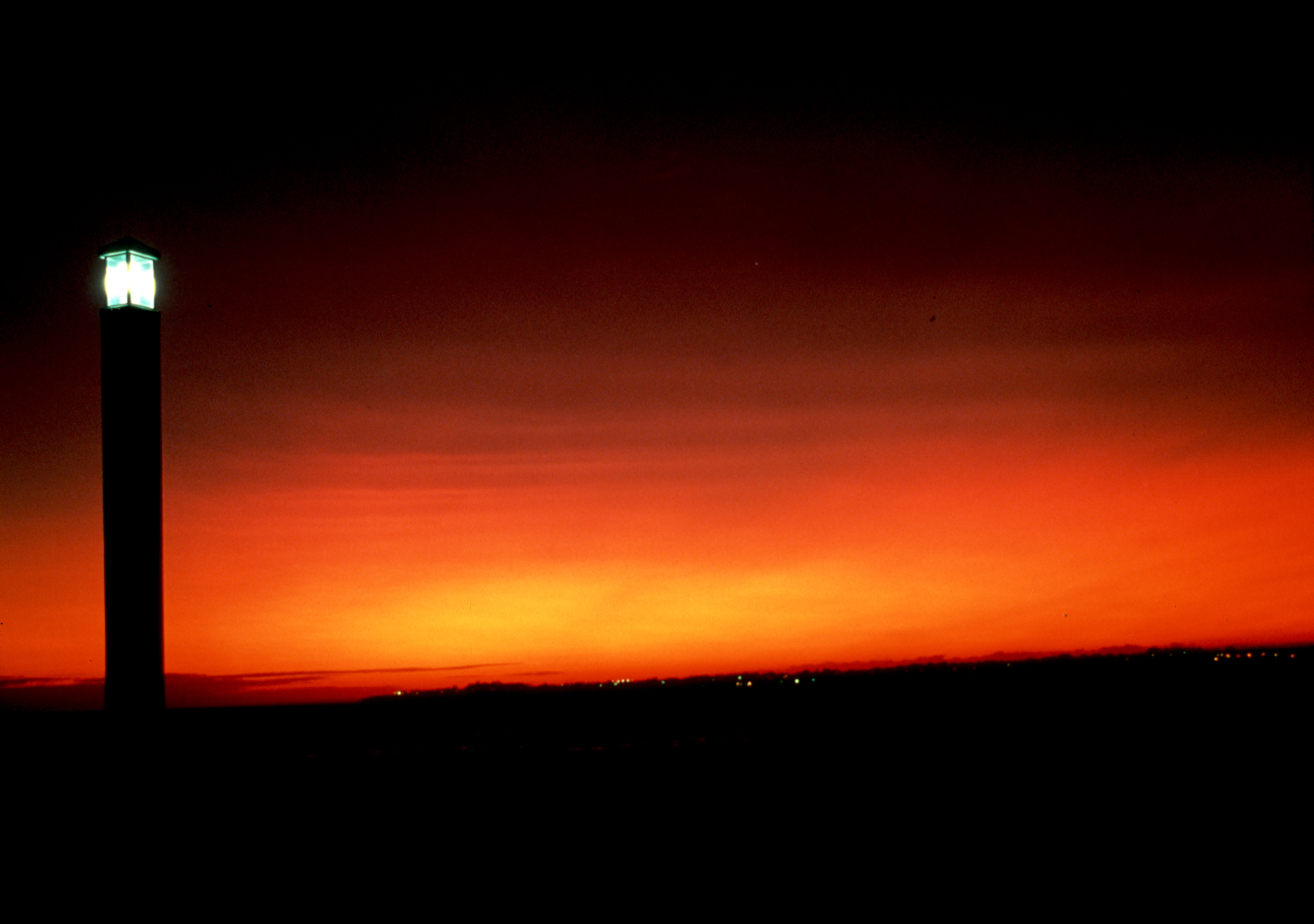
Sunsets look how they look because of light scattering off small particles in the air. The volcano presumably added more particulates, so it modified this.
- You can only offset a certain amount of warming with it. If you put too much aerosol into the stratosphere it will merge, become larger and precipitate quite fast. The exact possible offset can only be estimated, but is below what we're already committed to.
- You have to keep doing it. As soon as you stop you run into trouble very fast.
- In the models we see drastic circulation changes. For example the jet stream collapses. Do you want to test it in real life?
- The issue of ocean acidification still remains. The additional sulphuric acid in the environment won't help either.
- Ah and of course it's not cheap. We do not have the tech to do it yet in the amount necessary.
The currently easiest, cheapest and safest way to fight climate change remains to stop burning fossil fuels.
(edit: And of course I get you're not being serious.)
As always, also worth noting that this is literally acid rain. Putting it in the stratosphere is intended to lessen the amount of acid rain per warming averted, but it's still the exact same chemicals that caused acid rain. There are very good reasons we removed sulfur from gasoline.
Acid rain is probably better than global warming, assuming it doesnt literally kill the ocean. Its good that we have a potential backstop- we could definitely halt warming in a very short time and it might not kill all life. We can even produce the necessary sulfur for a short while. Or like, we could stop warming without dumping incredible amounts of acid in the air we breathe.
> we could definitely halt warming in a very short time
The limit estimated (from models) here [0] is a decrease of -2 W/m^2 at most.
The IPCC scenarios are equivalent with a number of plausible energy imbalances by the end of the century, ranging for 2.6 W/m^2 (RCP 2.6) in the best and 8.5 W/m^2 (RCP 8.5) in the worst case. [1]
So even in the best case it might very possibly not be enough to halt everything. Maybe it can buy us some time, but I think the only viable path forward is to stop as soon as possible and then carbon-capture it back.
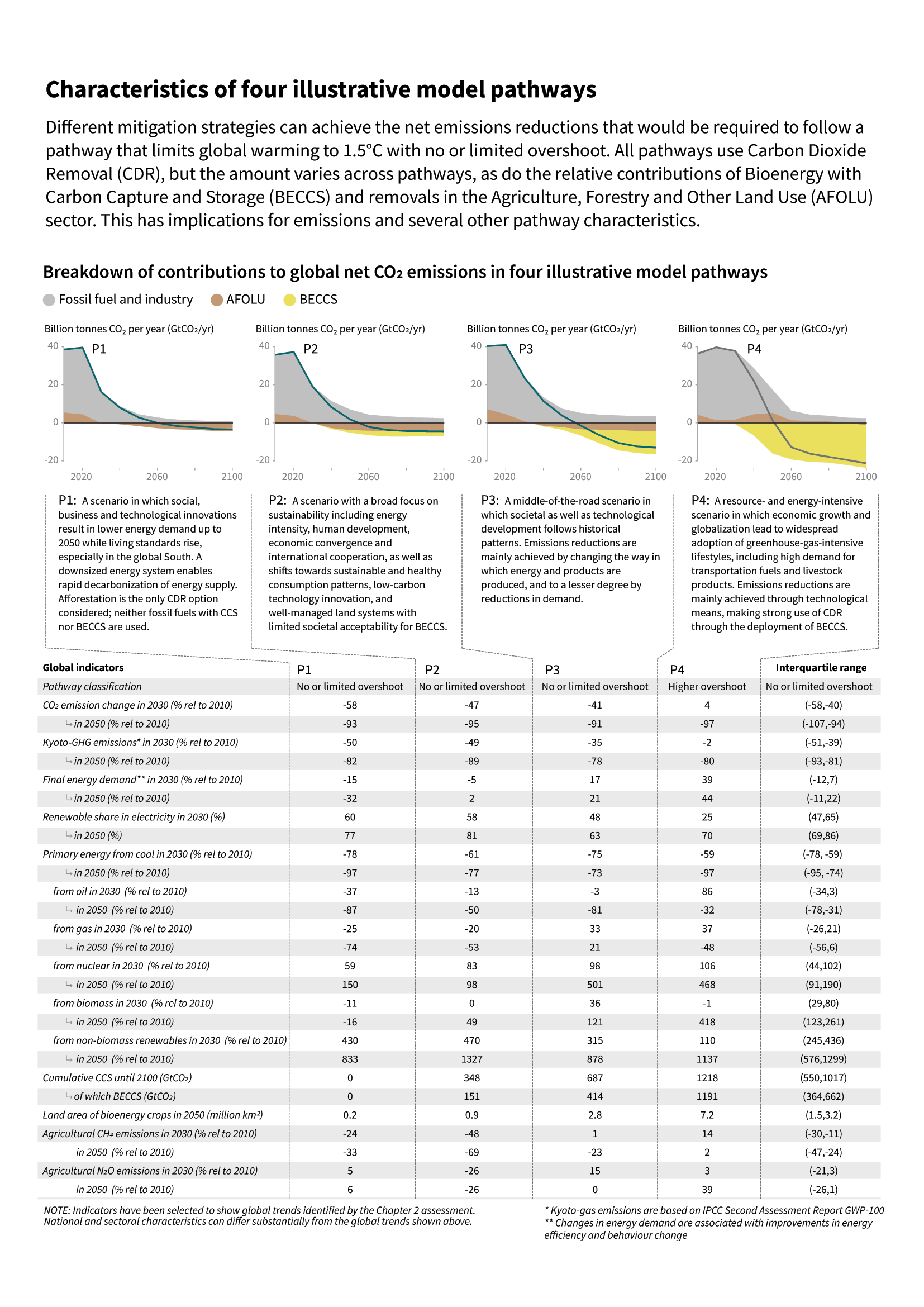
(See also this graphic [2] for possible pathways to stay below 1.5°C warming, all of which include carbon capture, up to half of current emissions starting in 10 years (in the best case by land-use changes, in all others by actively removing the carbon).)
It would require a very large eruption to make a worthwhile dent in the rate of warming; small-ish ones happen all the time with no strong effect. Even if such an eruption didn't have a lot of highly undesirable side effects, we simply don't have any way to trigger something like this. At any rate, the short-term consequences would be absolutely devastating and in no way cheap.
Okay, I'm sorry, I know this is a serious issue and people died but the year's alternative name 'Eighteen Hundred and Froze To Death' cracked me up.
But the most amusing part is how it affected culture. You can guess that agricultural shortages would lead to hunger and economic problems but it's kind of insane that it lead to the creation of "Frankenstein". Cause and effect is so interesting to follow.
One of the more unusual effects of the temporary climate change brought about by Mount Tambora’s eruption is that it may have indirectly led to the creation of the Mormon religion. Mormon founder Joseph Smith’s family was one of thousands that left Vermont during the freakishly cold summer of 1816. The Smith family subsequently settled in New York, where a teenage Joseph would go on to experience the events that led to his publication of the Book of Mormon. https://www.mentalfloss.com/article/73585/15-facts-about-yea...
"Saints" is a palatable book about the origins of the Church of Jesus Christ of Latter-day Saints. It is published by that church and members are encouraged to read it. It starts with an explanation of the year without a summer.
I am an active lifelong member, so take that into account when evaluating my opinion. But I think that this book would be a worthwhile read to anybody who is curious about the origins of Mormonism but not necessarily interested in joining. Yes, it's written by proponents. But I think it is objective enough to be worthwhile.
Oh, and Volume 2 was just released. Oh, and they are available for free. Even from Amazon.
My stake president mentioned the year without summer in his stake conference talk about Joseph Smith today. I'd never heard of it before, and then I check hacker news tonight and here it is again. Weird.
If you're interested in some other cause and effect surrounding Frankenstein, the phrasing of your comment made me think of this "History of Science Fiction" large art piece by Ward Shelley [0] (full sized 4400x2305 JPG here [1]). Frankenstein is near the center of the lower left quadrant.
The places that called it that saw 10-20 F changes. You also have an inaccurate conception of how much temperature changes over the seasons; Summer in the northern hemisphere is only 6 C warmer than average.




May 17, 1816 "[T]he spring has been unusually dry and cold. our average morning cold for the month of May in other years has been 63° of Farenheit. in the present month it has been to this day an average of 53° and one morning as low as 43°. repeated frosts have killed the early fruits and the crops of tobacco and wheat will be poor."
September 1816 "We have had the most extraordinary year of drought & cold ever known in the history of America. in June, instead of 3 3/4 I. our average of rain for that month, we had only 1/3 of an inch, in Aug. instead of 9 1/6 I. our average, we had only 8/10 of an inch. and it still continues. the summer too has been as cold as a moderate winter. in every state North of this there has been frost in every month of the year; in this state we had none in June & July. but those of Aug. killed much corn over the mountains. the crop of corn thro’ the Atlantic states will probably be less than 1/3 of an ordinary one, that of tob[acc]o still less, and of mean quality."
https://www.monticello.org/site/research-and-collections/eru...