I get it’s a joke, and often a frequent cynical joke made here, but I actually think it’s a good thought experiment. Almost like a new Turing test
The thought experiment, to be clear, is building an artificially intelligent CEO or company founder with the intent of generating profit. If this AI can turn a profit, it has passed this new test
Of course, by the time this new AI starts turning a profit, it will be maximized to the extent that it loses its competitive advantage, and then we’re back to square 1. That is, when everyone uses the same AI, nobody has a competitive advantage over anyone else
My current theory is that because of this, it is not possible to build an AI that generates a profit perpetually. Only temporarily. Then human intervention would be required to adjust things to make the AI competitive again. But at that point, it’s no longer an AI driving the profit, it’s its human tinkerer
You’re presuming here that CEOs cause companies to make profit instead of serving as a scapegoat for their often unavoidable market dynamics (at best).
I may be able to do all the labor myself, but need investors because I can’t afford the capital.
I may be able to do all the labor myself, but want to ensure continuity beyond my ability or interest to do the labor myself. (Sometimes this is by my wish; sometimes by the wish of consumers of my service.)
I may be able to do all the labor myself, but not want to expose my entire net worth to the financial obligations of the company.
There are plenty of cases where a single person company makes good sense.
At what point does a company become a company if one person doesn’t make a company? What’s the threshold for non-labor where a company becomes a company?
This presupposes that a company's competitive advantage comes primarily from their CEO.
It also presupposes that success is zero sum and winner takes all, which isn't always the case (example: when you're building out a new market segment, it can be beneficial to have competitors that are also building it out).
> This presupposes that a company's competitive advantage comes primarily from their CEO.
It’s the premise of the thought experiment: to be able to make a profit, the AI executor must achieve a competitive advantage in the market. If the AI doesn’t generate a profit, then it doesn’t fit the premise and that’s a different experiment
I suppose you can claim that a profit can still be generated by offering a holistically worse service/product with no single advantage than a competitor because markets are not efficient, though this may be short lived
Doesn't the incentive here, lead to privatizing the AI and possibly releasing a different product to the public - or at least with a delay? (not too unlike how the frontier labs work today).
Yes I would think that would be the endgame goal. But in practice, I’m very skeptical a purely AI-driven executor can stay competitive when the market and government supporting it and surrounding it is driven by humans
Yep. But, in most senses, trading algorithms don't need to interact with humans, or human society. Is the world around the "thought experiment" AI CEO dehumanized enough that that's also the case for it?
If not, I'd expect major problems there.
A related point - trading algo's can completely pivot in seconds, and live & die by extremely simple and short-term metrics. Even in a human-free world, that's not at all how the vast majority of industries work. What is "profit", when your AI CEO is organizing the construction of a new steel mill? Judging its performance then requires deep domain expertise.
> But a bit weird how a core American "surveillance = big no no" belief was thrown out in a few years.
I can't speak for China since I'm not as familiar with that culture, but as for the US, the culture has not changed, as you can see by protest campaigns like this and many similar types of protests (e.g. public destruction of Flock cameras). The culture in the US was founded on minimal government interference based on those trying to escape persecution elsewhere at that time, and that thread is still baked into many facets of US politics.
What has changed is the state. Surveillance has been growing constantly, to much of the disapproval of those who live in the US (e.g. Edward Snowden's revelations were very damning and the revealed surveillance was very much protested against, and likewise after the Cambridge Analytica leaks). But it's a bit of boiling frog syndrome for those experiencing it: the state can grow more controlling of our lives slow enough not to be perceptible, or to spin surveillance under manipulative politics, which is for example what led to bipartisan support of the Patriot Act. This makes it difficult to stop. Technology is especially a double edged sword for making this worse.
The useful idiots were happy to bury their heads in the sad and ignore the broader trajectory so long as the state threw them a bone from time to time. A few speed cameras here or there, environmental violation lead generation via location data there, maybe even a shotspotter deployment or two. It didn't take much to not just keep HN quiet, but to get their active support, as every brick in the road to hell was laid down.
Thanks for explanation. To be honest, that's what I've heard from my American friends as well, and I genuinely respect this position (as I agree somewhat agree with it). But at the end of the day, the results speak for themselves. Since it's a democracy, if it was an issue people cared about, they would have voted in someone in local/state/national level who would oppose surveillance, no?
I understand that it sounds a bit condescending to paint the whole nation in such manner, but this is what it looks like to me an observer with no skin in the game. And I understand that when you're in political minority, you can't really do much to change it.
I can't respond to a couple of dead comments under my post, like the one says "Difference is china uses to police speech. Police in US use it to catch scumbags". And this is exactly what I meant in my post. There's an interesting perception of "when X does it, it's definitely for bad stuff, but when WE do it, obviously it's for good". Again, sorry, I think I woke up in a shitty mood, and picking up fights.
> Since it's a democracy, if it was an issue people cared about, they would have voted in someone in local/state/national level who would oppose surveillance, no?
The US is a representative democracy, which means US citizens can't vote directly on laws (most of the time--e.g. CA has a system that allows some direct democracy). Those elected decide, and usually those elected aren't elected because of their views on surveillance but rather something else (e.g. jobs). For example, there's been places where citizens have majority wanted Flock cameras removed, but the local government doesn't do anything about it. Similarly, most US citizens don't believe elected officials should be allowed to trade stock, but elected officials have never enacted that into law.
There's a constant force for the state to become more powerful and authoritarian. I think it's the natural state of things. Why wouldn't a politician want more power? Fewer in power would argue against that.
At least in the US, this was foreseen at its founding, so the original constitution was designed to water down the federal government's ability to lord over everyone's lives (e.g. the bill of rights). But those in power are constantly seeking to undermine it. And that's where we're at today. Constantly trying to uphold our rights against a state that naturally gravitates towards more power.
That's wild. If Anthropic is willing to risk ruining the trust of their userbase for the sake of protecting their moat, it makes me wonder how strong of a moat they have to begin with
That overall drop in share of income since 2000 is related to the "giant sucking sound" Ross Perot warned about in 1992:
"It's pretty simple: If you're paying $12, $13, $14 an hour for factory workers and you can move your factory South of the border, pay a dollar an hour for labor, ... have no health care, that's the most expensive single element in making a car, have no environmental controls, no pollution controls and no retirement, and you don't care about anything but making money, there will be a giant sucking sound going south."
While Perot was warning about NAFTA, the jobs did go elsewhere: China and other countries with cheaper labor. Globalization led to labor competition, which increased the supply of workers.
Meanwhile, companies captured the value of the increased supply of workers. More cheap labor = more production, for a world that had latent demand for cheaper output. It ended up a net benefit for businesses (capital owners), and overseas workers. This is at least partially if not significantly where the growing gap between wage growth % and GDP growth % comes from.
The macro economists were right that globalization would be more efficient overall for the world, economically. But that came at the expense of the US labor that saw its wage growth eroded as a consequence.
The submitted title is a bit sensationalist given the article’s conclusion:
> Is this decline a distinct change from the recent behavior of the labor share in the U.S.? Along the two key dimensions we investigate, our answer is no. First, the labor share’s trajectory post-COVID broadly follows the cyclical patterns observed in earlier recessions, with a decline during the recovery phase that mirrors historical dynamics. Second, the decline in the labor share since COVID is driven primarily by within-industry changes rather than shifts in economic activity across sectors. Taken together, these results suggest that the post-COVID decline follows the same cyclical patterns as earlier recessions and is driven by the same within-industry forces, and they provide little evidence that it will evolve differently from past episodes.
What I find more interesting is the sharp drop around the early 2000s
I'm highly anticipating the answer to the great question of life, the universe, and everything
On a more serious note, I found this interesting from TFA:
> The biggest question, though, is what sorts of rules should be put in those constitutions in the first place. Philosophers have zeroed in on two main ethical frameworks. One is deontology. Popular with Kant, among others, this imposes strict rules that prohibit things like lying, coercion and treating people as a means rather than an end, even if it is for a greater good. Anthropic’s constitution incorporates many deontological strictures. These can make AI behaviour more consistent, says Dr Powers—a plus for deploying robots in homes and public spaces.
> The other approach to ethics of interest to philosophers of AI is called consequentialism. It weighs costs against benefits to decide what to do. Models more sympathetic to consequentialism include OpenAI’s ChatGPT and Google’s Gemini. Google’s AI models are designed to produce “likely overall benefits [that] substantially outweigh the foreseeable risks”, a classic consequentialist goal.
As a big fan of the trolley problem thought experiment, I am very curious what led to this ethical split between these model makers. I find it darkly humorous and also scary to think about the choices these models could make to influence people and decisions, especially if it's under a utilitarian perspective
The trolley problem is probably the most famous thought experiment in ethics, but it doesn't do a good job of distinguishing ethical theories. Both utilitarianism and Kantian deontology agree that it's correct (or at least permissible) to flip the switch. The Kantian argument is that you are not treating the one person merely as a means—you save the five via the second track, and they would still be saved even if the one person wasn't present.
There's a sort of intuitionist deontology that says it is wrong to ever perform an action that causes someone to die, but only 13% of philosophers[1] say you shouldn't switch, compared to 63% who say you should.
Most big companies attract rule followers. They err on the side of avoiding taking risks like this, which is why they work there (and why there’s so many in this thread talking about rules). It benefits big companies to have mostly rule followers because you can’t have a too many people going in different directions. You need stability and a unified direction, that usually comes from the rulers making the rules. The fewer rule breakers generally find their way to the top, or get canned
This employee’s decision to break the rules, while addressing a real need in the market, must have really pissed off some people above, for better or worse. Google could have just rolled with it but I’m sure it would have stepped on someone else’s plans. Career defining moment, but they didn’t have the political capital it seems. I don’t think they will have much trouble finding work elsewhere though
See also: Power: Why Some People Have It--And Others Don't
Corporations have money and money attracts lawyers. Some discipline would have been required for the trademark stuff because you have to be very careful about it or lose your job.
Now, did something cause other issues that converted this from formal "don't do that, use the official process" and nothing more? Sounds like something caused this to escalate. It could be toes were stepped on, could be a bad reaction to the warning, or could just be wanting to cut employee numbers in a shortsighted way.
That's the point of why they're doing it. From TFA:
"Private equity investors are turning to AI-generated replicas of software to assess whether acquisition targets have a competitive advantage
[...]
'We are leveraging vibecoding to show what a software company can and can’t do, to understand where it fits in the value chain and to understand whether it is the actual code that is the defensible part of the business or something else,'"
In the article, they explain the goal of vibe coding prototypes is not to rebuild software, but to test the defensibility of businesses based on their software so they can decide whether to acquire them or not


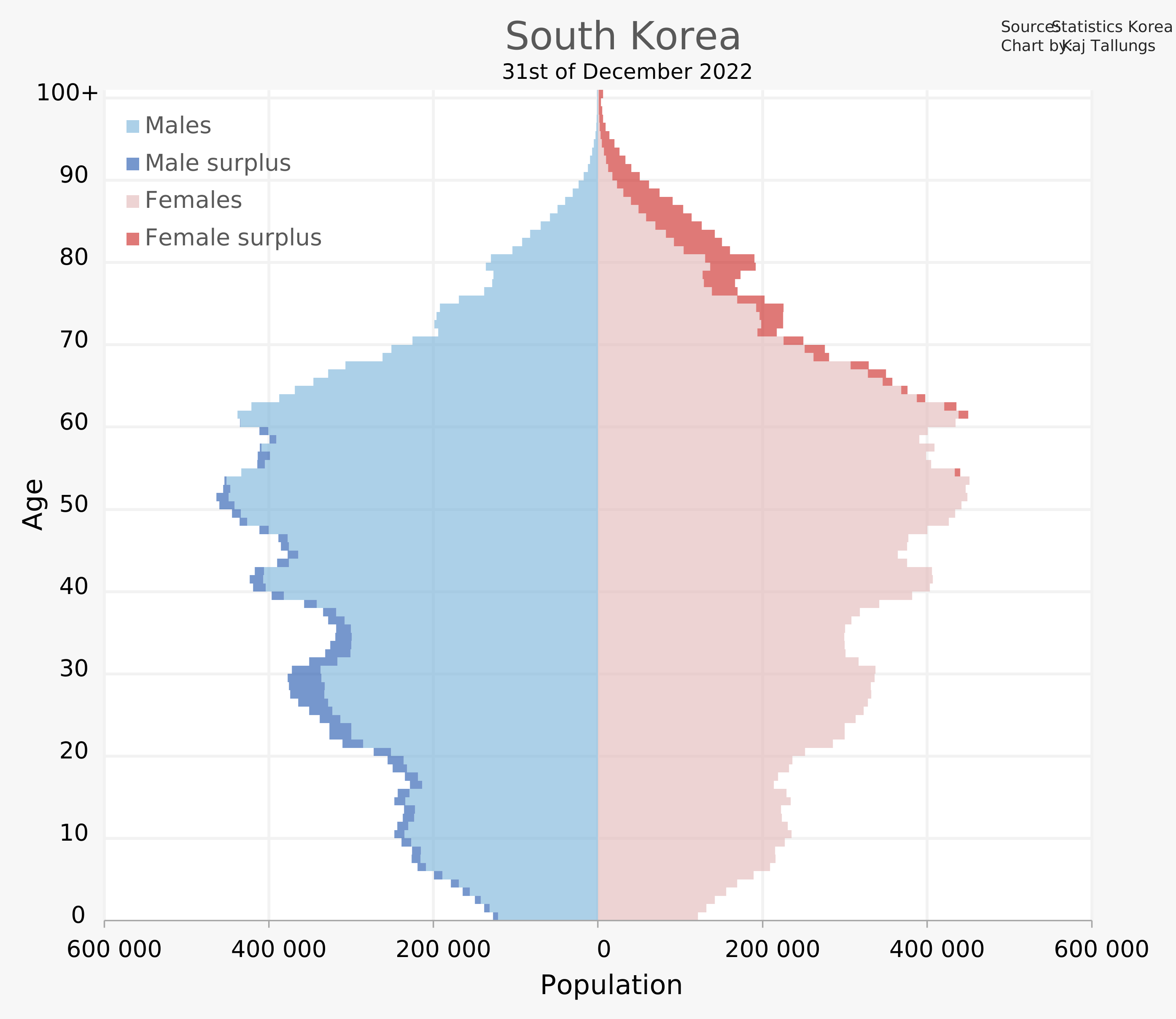


The thought experiment, to be clear, is building an artificially intelligent CEO or company founder with the intent of generating profit. If this AI can turn a profit, it has passed this new test
Of course, by the time this new AI starts turning a profit, it will be maximized to the extent that it loses its competitive advantage, and then we’re back to square 1. That is, when everyone uses the same AI, nobody has a competitive advantage over anyone else
My current theory is that because of this, it is not possible to build an AI that generates a profit perpetually. Only temporarily. Then human intervention would be required to adjust things to make the AI competitive again. But at that point, it’s no longer an AI driving the profit, it’s its human tinkerer